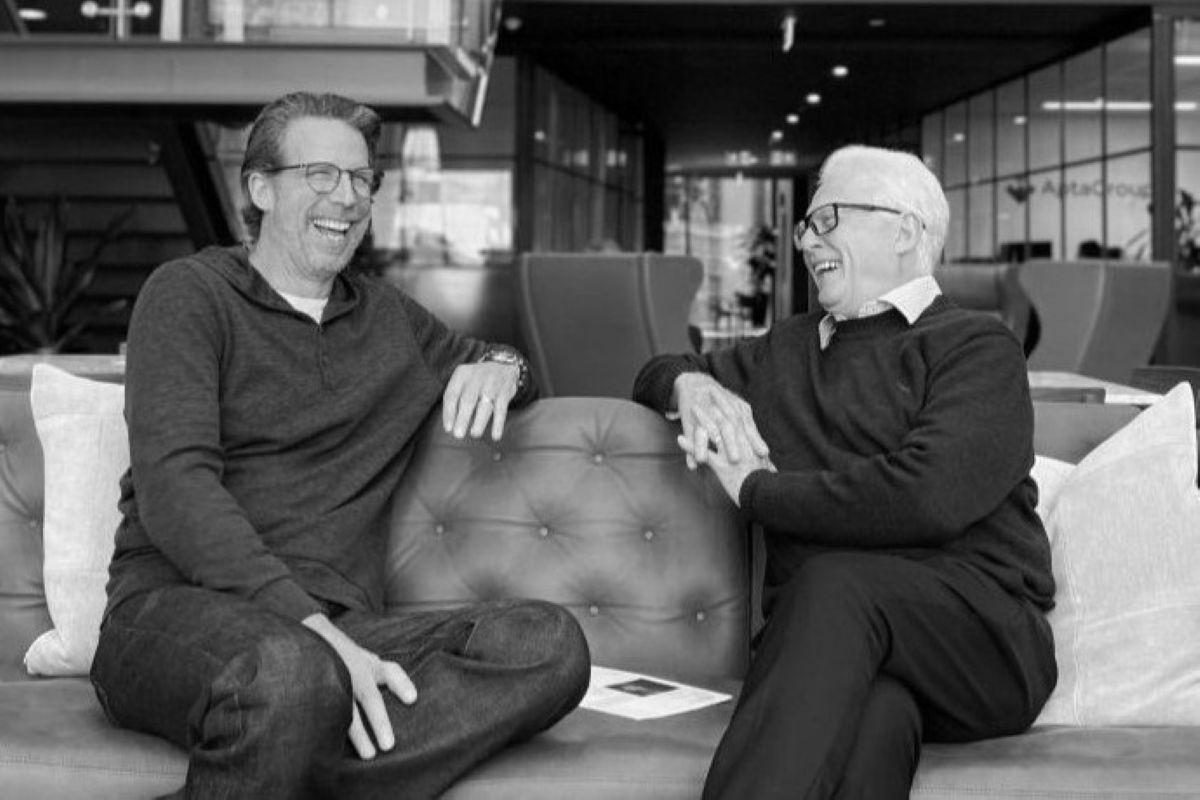
Leadership today requires far more than technical expertise or positional authority. It demands judgement, intellectual curiosity and the capacity to navigate competing truths and ambiguity. ECI Partner, Chris Corneil, speaks with Professor John Shields, former Deputy Dean at The University of Sydney Business School, about the ideas that have shaped his thinking over decades in academia: from critical inquiry and stakeholder balance to humility, coaching and the enduring human qualities that define effective leadership.
Chris: John, let’s start where LinkedIn doesn’t. What would people be most surprised to learn about you?
John: Probably that I have criminal DNA.
On both sides of my family, I have multiple convict ancestors, around ten over six generations. For most of the 19th century, my family tree is basically convict-to-convict transmission of DNA, and I’m proud of that.
The first recorded convict was George Shields, sentenced to death in 1806 for stealing silver candelabras through an open window in London. Because of labour shortages, the sentence was commuted to transportation for life. He arrived in 1808, behaved himself, received a land grant from Governor Macquarie, and became a small settler on the Hawkesbury River. He lived into his 60s; had he stayed in London, he likely wouldn’t have made it past his mid-30s. I like to say I owe my life to the British penal system.
Chris: A few generations on, you’re a professor and former Deputy Dean at one of Australia’s leading business schools. How did that journey unfold?
John: I was the first in my family to attend university, back in the 70s. I studied Arts because I thought that’s what university was for. I majored in history, and I still think like an historian – that’s how I make sense of everything.
After ANU, I started a PhD at Syd Uni, took too long to finish, then got my first academic job at UNSW. In 2000 I returned to Syd Uni, and I’ve been very happily rusted on ever since.
Chris: The world your students are entering is hyper-digital and deeply ambiguous. Is a broad, liberal education still essential?
John: Absolutely.
We’re a business school, but our Commerce degree has a strong liberal studies undercurrent focused on higher-order critical thinking and personal and professional values and responsibility. These have become essential in a world of generative AI.
It’s not enough to be AI-fluent in the sense of being able to prompt a bot. You have to interrogate what the bot gives you. The bot says, “Here is the truth.” Your job is to ask, “Do I accept that? Should I probe for a different truth I’m more intellectually comfortable with?”
We prepare students to operate in a VUCA world – and A for ambiguity is the big one. There often isn’t a single definitive truth. Our students see competing narratives every time they open social media. Learning to live with and work with ambiguity is now a core capability.
Chris: You’re operating in a complex system: academia, business, policy, social expectations. How do you align such diverse stakeholders?
John: It’s design thinking 101.
Who are the stakeholders? Who are the personas within those groups? What do they need? Where are those needs in tension or contradiction?
As a business school we listen to graduates, employers, regulators, and the wider community. We think deeply about our social licence, including ESG obligations. Then we try to balance those needs in a well-informed way.
It’s a constant act of rebalancing that requires unlearning old assumptions about what employers want, what students value, and what society expects of institutions like ours. Boards face the same challenge. There’s no permanent answer – only a commitment to continuous improvement and timely recalibration.
Chris: You’ve researched and taught leadership and HR for decades. What have you personally learned about leadership?
John: Much of it has been hard-won.
I now focus on individualising relationships. Yes, colleagues belong to tribes and disciplines, but I try to relate to each person individually. That’s how you build trust and signal, “I’m here to help,” in a servant-leadership sense.
You can’t do that with 500 staff as a Dean, but you can do more of it than most leaders think. One-on-ones, small groups, brown-bag lunches – the format doesn’t matter. Reaching out does.
For me, leadership legitimacy comes from engagement and having the courage to show humility and vulnerability. It’s the willingness to say, “I don’t have an answer yet. Let’s work through the options.” I’m constantly trying to practice the mentoring and coaching capabilities that you have helped me with in the past, and for which I am extremely grateful. I have found these approaches immensely valuable and they have transformed the way I seek to manage work relationships up, down and across the organisation.
Chris: Let’s talk about AI. Are you optimistic or anxious about its impact on work and leadership?
John: Both.
Every major technological shift creates winners and losers. AI will be no different. My test is an old-fashioned one: does it benefit more people than it disadvantages?
I see huge upside. We’ve just launched an MBA that integrates strategic thinking with digital capability. Some of the incoming students I’ve spoken with are tremendously excited about using AI to transform the caring professions: childcare, aged care, healthcare, and enable things like safe remote surgery. That’s extraordinary.
But some roles will disappear or be reshaped. Law and accounting are already being transformed as AI takes over routine tasks. That’s why we’re doubling down on enduring capabilities: metacognition, critical interrogation of AI output, and the ability to work in cross-functional, cross-cultural teams in a digital environment.
Every industrial revolution destroys some jobs and creates others. This wave will do the same. Our responsibility is to prepare people for roles that don’t yet fully exist.
Chris: In that future, what remains fundamentally human?
John: Self-determination theory nails it: autonomy, relatedness and competence are the three fundamental psychological needs in the world of work.
I’d add care and kindness as the normative overlay. Our need for connection, belonging and dignity is enduring. Kindness may sound naïve, especially if you scroll social media or watch global conflict, but it’s a deeply human value aligned to a simple Kantian ethic: “Do no harm”.
I’ve never been tribal, and I now actively challenge tribal thinking because it marginalises people who aren’t “in the tribe.” In a fractured, angry world, choosing non-tribal, kind leadership is both radical and necessary.
Chris: You’ve had significant executive coaching yourself. What difference did it make to how you lead?
John: Two things in particular.
First, it made me more humble. It stripped away the idea that leadership is about the uniform or the epaulettes. I realised that to be effective, I had to listen better and be more emotionally attuned to people’s undercurrents, especially those very different to me.
Second, it sharpened my ability to process what people are saying, to synthesise their concerns and aspirations and reflect them back in ways that clarify the issues. Colleagues have told me they value that.
Humility, active listening and effective processing, that’s the triad coaching strengthened for me. Now, in the later part of my career, I see mentoring and informal coaching as a form of giving back. It surfaces hopes, fears and possibilities in ways I’d never seen before, and I’ve learned a lot about myself through the process. It gives me a continuing sense of purpose.
Chris: Looking ahead, what will distinguish the most effective leaders in universities, business, government, anywhere?
John: A blend of attributes that are deceptively simple and incredibly demanding.
Humility is non-negotiable. Leaders no longer monopolise information. Your job is to leverage the knowledge of people who may be organisationally subordinate but possess critical expertise you don’t have. That’s really the essence of the servant leadership ideal: “I’m here to serve you, not just to lead you.”
Active listening is essential. And hubris is organisational death. I’ve seen that movie, it doesn’t end well.
The other critical quality is courage. Courage and hubris aren’t the same. You can be humble and courageous. In fact, that’s the sweet spot: a will to influence things for the better, balanced with the humility to know you don’t have all the answers.
As Jim Collins has proposed, leaders who can balance will and humility in a dynamic, self-aware way will both have impact and garner trust – and do well and be a force for good in a world that’s getting more and more complex and ambiguous.
Professor John Shields
Professor of Human Resource Management and Organisational Studies, The University of Sydney Business School
To connect with us about executive coaching please contact us here.